Sci. Rep.Scientific Reports, 2024
Importance of OCT-derived biomarkers for the recurrence of central serous chorioretinopathy using statistics and predictive modelling
TL;DR Using AI-extracted biomarkers from 5,211 OCT scans, we identify nine predictors of central serous chorioretinopathy (CSCR) recurrence.
This work was carried out at the Jules-Gonin Eye Hospital (Lausanne) during my data science internship.
Abstract
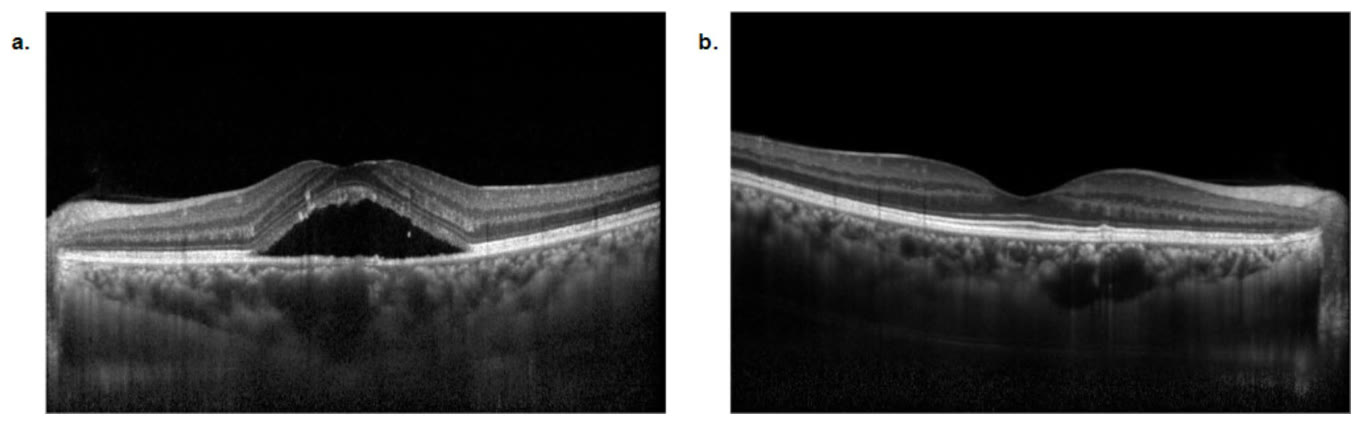
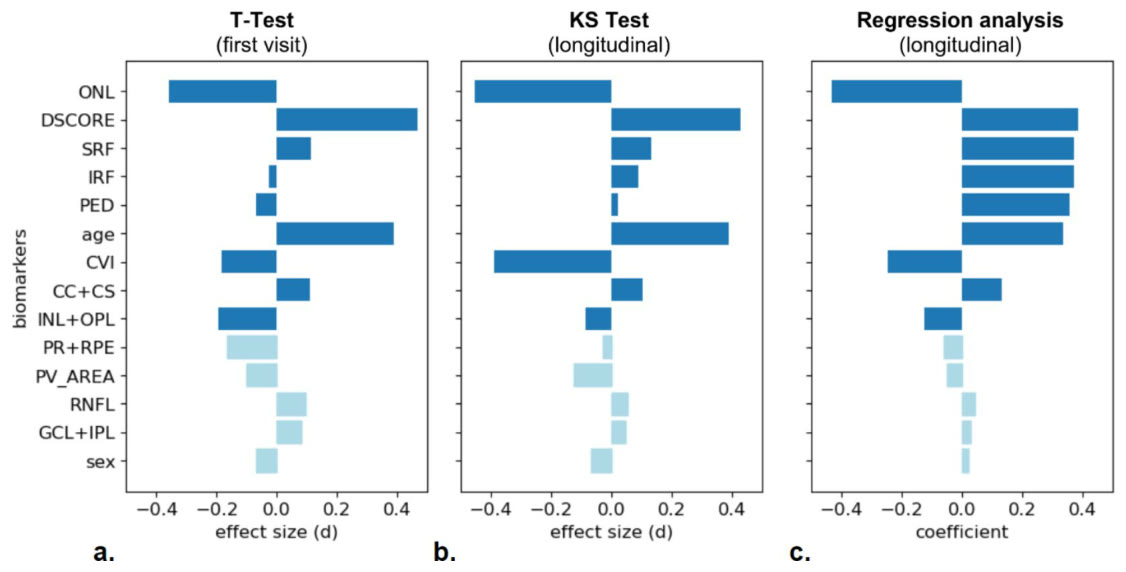
Central serous chorioretinopathy (CSCR) is a retinal disease characterised by the accumulation of subretinal fluid, which often resolves spontaneously in acute cases. However, approximately one-third of patients experience recurrences that may cause severe and irreversible vision. This study aimed to identify parameters derived from optical coherence tomography (OCT) that are associated with CSCR recurrence. Our dataset included 5211 OCT scans from 344 eyes of 255 patients diagnosed with CSCR. 178 eyes were identified as recurrent, 109 as non-recurrent, and 57 were excluded. We extracted parameters using artificial intelligence algorithms based on U-Nets, convolutional kernels, and morphological operators. We applied inferential statistics to evaluate differences between the recurrent and non-recurrent groups, and we used a logistic regression predictive model, reporting the coefficients as a measure of biomarker importance. We identified nine predictive biomarkers for CSCR recurrence: age, intraretinal fluid, subretinal fluid, pigment epithelial detachments, choroidal vascularity index, integrity of photoreceptors and retinal pigment epithelium layer, choriocapillaris and choroidal stroma thickness, and thinning of the outer nuclear layer, and of the inner nuclear layer combined with the outer plexiform layer. These results could enable future developments in the automatic detection of CSCR recurrence, paving the way for translational medical applications.
Citation
@article{seiler2024importance,
  title   = {Importance of OCT-derived biomarkers for the recurrence of central serous chorioretinopathy using statistics and predictive modelling},
  author  = {Seiler, Emilien and Delachaux, Léon and Cattaneo, Jennifer and Garjani, Ali and Martin, Thibaud and Duriez, Alexia and Baffou, Jérémy and Mousavi, Sepehr and Meloni, Ilenia and Bergin, Ciara and Tomasoni, Mattia and Eandi, Chiara Maria},
  journal = {Scientific Reports},
  year    = {2024},
  doi     = {10.1038/s41598-024-75275-7}
}